Failing
The EDS Society and EDSUK are two of the most known Ehlers-Danlos charities.
They have undoubtedly helped people suffering with this connective tissue disorder.
However, despite them blowing their own trumpets and positioning themselves as some kind of saviours within the EDS world, both are failing – which is something I’d be amazed to see either organisation admit.
History
The EDS Society, originally the EDNF (Ehlers-Danlos National Foundation) was first formed in 1985, and EDSUK came along in 1987.
I remember the EDNF and I remember when EDSUK was the EDSG (Ehlers-Danlos Support Group). While both have done some great things, such as devising the Villefranche nosology, which gave a framework to the classification and diagnosis of EDS, neither have gone far enough and both have been making mistakes for decades.
This nosology was pretty much replaced since its inception, and the waters were muddied by the introduction of HSD (Hypermobility Spectrum Disorder), which shares many, if not most, of the symptoms associated with Hypermobile Ehlers-Danlos Syndrome (HEDS).
In the eyes of those who aren’t unconditionally loyal to the charities, the introduction of HSD did more harm than good, and was more about securing cash than actually helping bendy bodies.
They both have fanbases, loyal online cheerleaders who appear to think neither charity can do any wrong and who would fight their corners and rally against any criticism levelled against them.
There are, though, also some closed Facebook groups set up purely to discuss the issues and negative impacts of the charities.
Negative things that I’m going to cover in this feature.
Negative things I don’t say lightly.
While most of what I say applies to the EDS Society and EDSUK, because I am in Britain, my main focus will be on the latter.
I also used to work for EDSUK as editor of their magazine, Fragile Links, giving them around £50,000 worth of work free of charge over the course of a couple of years. The trustees would send me an envelope of bits and bobs they wanted in the magazine, and I’d decide what else should go into it.
I gave the charity their name, persuading trustees to stop calling it a support group and start using EDSUK.
My ambition was to write and produce a publication EDS sufferers could learn from and take to medical appointments to put under doctors’ noses and help them get the care they needed.
The budget for Fragile Links was pretty much non-existent then, so the only colour that could be used was the charity’s red that was in their logo at the time, and I persuaded a local printing company to do us a deal where we got a discount for the print run and that red was included at no extra cost.
I came up with their slogan - ‘Education. Information. Communication.’ – and put the publication together in software designed for building websites, not magazines. That alone was an arse ache, but I was determined to contribute and use my skills to try helping the charity help others.
Having printed out the magazine, I’d stick the A4 pages together, then send them to the trustee to go through. We’d discuss any alterations that needed to be made, then I’d email the files to the printer, and the charity would receive boxes of Fragile Links to post out to people.
I also gave the charity their name, persuading trustees to stop calling it a support group and start using EDSUK based on my prediction that an international network of EDS organisations was going to develop - as it has.
And so, in the early 2000s, the Ehlers-Danlos Support Group (EDSG) became Ehlers-Danlos Support UK (EDSUK), which identified them as this country’s primary EDS organisation and gave them a more credible and official image.
They still use the name I gave them today.
I ended up dumping the job due to so much needless arguing between the trustees at that time.
While EDSUK still position themselves as the country’s primary EDS charity, they could do with some help with the copy (words) in their website, which is full of errors and not well written. I’d volunteer to help them free of charge, confident as I am that I could do a better job than whoever it is they pay to write and build the site for them, but, as far as I’m concerned, they’ve pissed on their chips in several ways.
Allow me to elaborate…
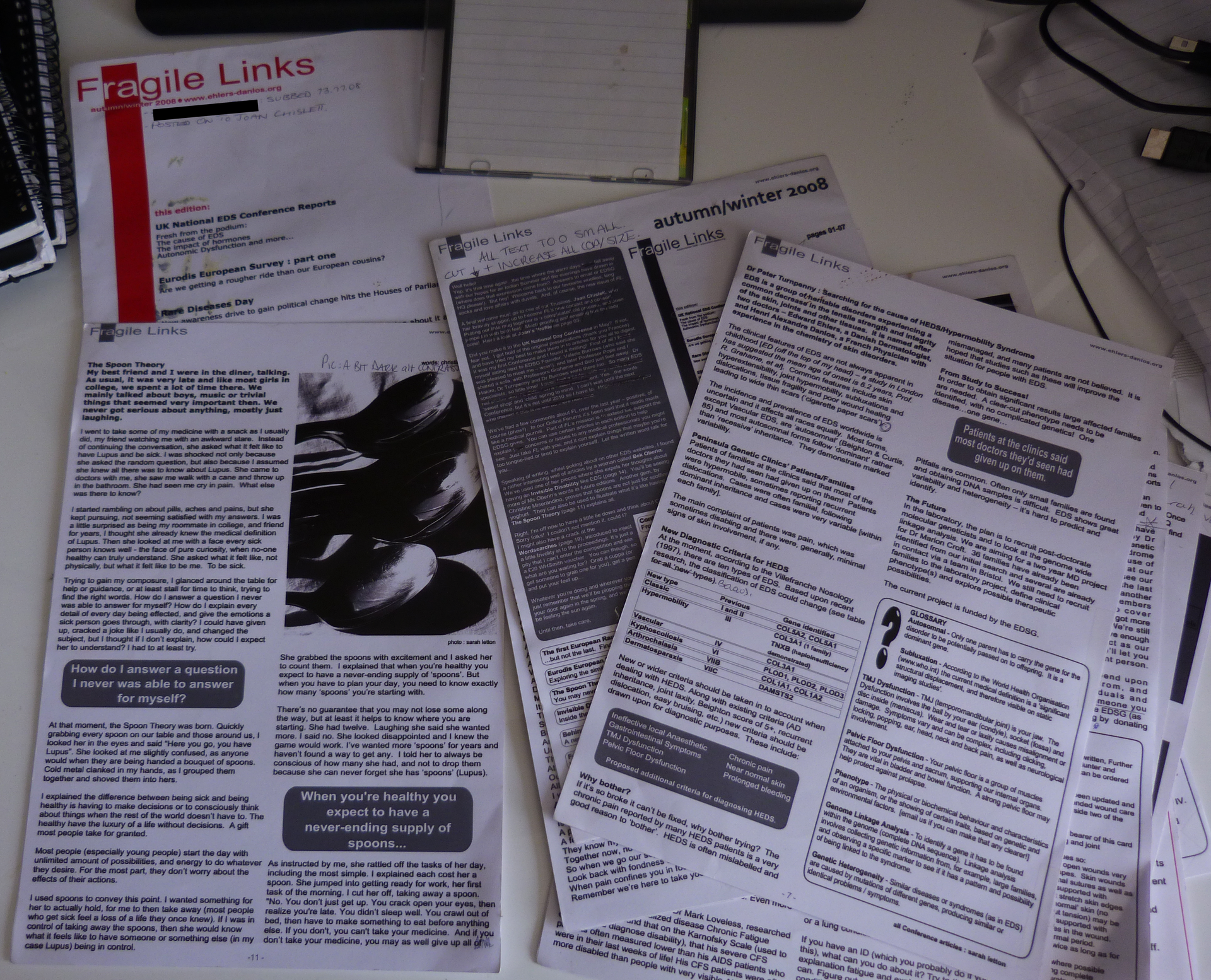
A working copy of Fragile Links from 2008 I still have. This edition included the now famous 'Spoon Theory', hence the photo of spoons I took in my kitchen.
Lies
They lie. Not only are they failing EDS suffers in this country, they also lie.
Several years ago, I and several others started asking them questions on Facebook that they did not want to be asked or answer.
Rather than address our concerns, they chose to block us. So, we no longer have access to their Facebook page. This was before Instagram blew up into the monster it is today, and Facebook was the primary social media platform.
They deny blocking us - which means they are lying about doing so. This is very bad form for any charity, especially when their reasons for blocking people basically equate to them wanting to avoid answering valid questions and dodge the accountability the organisation has chosen to bestow upon itself.
You can’t position yourself as a medical condition’s primary national charity (which includes establishing things like diagnostic criteria and how sufferers are treated medically), then refuse to answer questions from the people you profess to serve and support.
They are Ehlers-Danlos Support UK, yet they pick and choose which sufferers they’ll support.
Blocking those of us asking valid questions, then lying about doing so, is beyond poor form.
I know I’m not the only person they have done to this to, because the issue has been discussed in a closed and somewhat covert Facebook group dedicated purely to discussing EDSUK and the EDS Society.
Aside from the ethics of these lies, there are other far more serious ways in which EDSUK are failing - ways that impact very seriously on many people’s lives and may, worst case scenario, even cost lives.
Ignorance
Like many, I’ve been battling doctors who know nothing about EDS for decades. I say, with complete confidence, that there is not a medic at any level in the whole of NHS Wales who knows as much about EDS as I do.
Chances are, outside the small circle of EDS specialists in England, the same is true within NHS England and NHS Scotland too.
This is not something I take pleasure in saying. It should not be this way. I’d put £1000 on it being true, not only because of my personal experience, but also because of what I see being said in online EDS groups, and also because of the sufferers I’ve advocated for in person, standing between them and the consultants dealing with their care.
When I was EDSUK’s editor, I had a telephone conversation with a mother who experience such ignorance, it cost the life of her 18 year-old son.
Finn died of what the pathologist described as ‘an intestinal explosion’. Had his medical
team listened to his mother it would have extended his life, given him more time.
Named Finn, she had been begging surgeons to perform surgery on him to stop him experiencing a catastrophic rupture in his digestive system. They kept refusing this request, incorrectly stating that internal ruptures never happen in HEDS, only occurring in VEDS (Vascular Ehlers-Danlos Syndrome).
They were wrong.
Finn died of what, after a postmortem (autopsy), the pathologist described as ‘an intestinal explosion’.
Had his medical team listened to his mother and performed the surgery, it may not have stopped him dying at some point, but it would have extended his life, given him more time.
That conversation is still as clear as day in my mind. I can still see the back step upon which I was sitting when we spoke. I can still see myself after we hung up, in my kitchen thinking why did Finn rupture? I can still hear the heartbreak in her voice, feel the silent rage in my stomach.
Rage that I used to fuel research. I may not have been able to bring her son back, but maybe, just maybe, I could find the reason for the rupturing, write about it for Fragile Links, and give other Bendies an article they could give to their medical teams that might help save some lives in the future.
In the end, my research led me to the TNXB gene and Tenascin X, a protein that sits between our collagen proteins, contributing to the extra cellular matrix of the cells making up our bodies.
I knew I was on the right track when Professor Rodney Grahame, one of the world’s top and most respected EDS specialists, shook my hand and congratulated me on that short piece at an EDS conference organised by EDSUK.
Today, the involvement of the TNXB gene and Tenascin X proteins in EDS is far more documented and understood. As it should be.
What, though, does this have to do with EDSUK failing us?
Every doctor I’ve tried discussing this with has never heard of the TNXB gene and has no idea of the potential significance and risks of Tenascin X issues in HEDS. Some of us have tried to get our local NHS Genetics Services to test us for this gene and have been refused what could be a vital test in terms of not only our safety, but also that of our children, grandchildren and every descendant who may inherit this dangerous and potentially fatal problem.
Testing for the gene should be a standard practice for anyone diagnosed with HEDS so that those who carry it can then receive regular scans to keep an eye on the structural integrity of their internal organs and major blood vessels such as the aorta.
It’s known that aortic dissection and/or rupture is an issue in VEDS, but in HEDS, most medics who know the bare minimum about EDS won’t know, and generally do not accept, that the same issues can come with HEDS – as is the case with my local Genetics Service who claimed that internal organ rupture and aortic issues never happen in HEDS.
But they have probably never heard of the TNXB gene and wouldn’t know it if it came up and kicked them in their ignorant faces.
And herein lies one of EDSUK’s failures - ignorance within the medical profession.
EDSUK tends to target us - the EDS patients – when it should be focusing on targeting and educating NHS staff so that we receive the care we should be receiving.
So we are not dismissed and damaged, maybe die, because doctors, surgeons and geneticists don’t know enough about EDS to know how little they know.
Yes, sufferers should be educated and informed, but medics
should know more.
Gaslighting
This ignorance within the NHS often leads to EDS patients experiencing medical gaslighting – where we are contradicted, told incorrect information and told we are wrong when we know we are right.
I’ve experienced this numerous times over the years.
I tackle it by slapping printouts of PubMed abstracts and articles under medical professionals’ noses.
They may not know EDS, but they know PubMed printouts when they see one. It’s the research resource the international medical system uses for research.
There is no more a credible source than PubMed.
Any medic ignoring PubMed information knows they are potentially risking their license to practice and could face an expensive law suit if something goes wrong and they are sued.
If EDSUK were not failing us in terms of not targeting and educating the NHS, we wouldn’t have to fight so hard for the most basic things.
I’ve used PubMed papers to shut down medical staff and get the care needed not only for myself, but for other people too. It’s something we should not have to do.
And if EDSUK were not failing us in terms of not targeting and educating the NHS, we wouldn’t have to fight so hard for even the most basic things.
One of my experiences of medical gaslighting involved an arrogant doctor who was cutting a mole out of my leg. It’s been known and documented for years that some of us Bendies do not respond to local anaesthetic (lignocaine/lidocaine in particular).
I’d informed the doctor this is the case for me and I tend to need at least twice the usual dose to be numbed, but he didn’t believe me and started cutting into my flesh.
I told him I could feel it. He didn’t believe me, told me I could not feel his scalpel. He only stopped cutting and injected more when the nurse who was also in attendance told him she could see pain responses in my eyes.
I’ve also had dentists refuse to believe me before they start drilling in to my teeth. The dentist I saw recently was one. A filling had fallen out of one of my back teeth and she was sorting it out for me. Before I let her get near me, I told her how I am hard to numb and usually need at least twice the usual dose.
She didn’t believe me, told me I shouldn’t be able to feel my tongue. I told her I could. She started drilling anyway, stopping only once she started drilling and saw me reacting to the pain.
Then and only then, did she inject more.
But my tongue still didn’t lose its feeling as it should have.
Another example of the medical gaslighting and disbelief I’ve experienced involves being stitched. I’ve told medics that severe HEDS means my healing is appalling and IV needles (cannulas) and even slight scratches scar me permanently, so I need more stitches placed closer together than in normal bodies, and they need to be left in around twice as long as normal.
That too has been ignored, and I’ve had stitched wounds reopen and spread once sutures have been removed. My fault, perhaps - I shouldn’t have let the stitches be removed.
This ignorance and gaslighting has also negatively impacted my medical care in terms of tests.
In September 2025, I ended up walking out of my local NHS A&E (Accident & Emergency) department because staff there refused to hear what I was saying and wanted to perform a potentially dangerous test I refused to allow.
EDSUK is failing in terms of not educating the NHS and predominantly targeting us (often with their fundraising begging bowl in hand)...
There for a potential brain bleed, they wanted to do a lumbar puncture, which meant piercing the membrane around my spinal cord. Depending on the result of that, they would then do an MRI scan of my brain.
I refused to let them do the lumbar puncture because my healing is so poor and it could have left me with a permanent hole in that membrane, which would mean a permanent leak of my CSF (cerebrospinal fluid – the fluid in and around your spinal cord and brain), permanent pain and permanent infection risk.
Believe me, when your CSF pressure drops, leading to your brain dropping slightly within your skull, the pain it causes is hideous.
The staff refused to hear me and just jump to the safe MRI scan. They were also working off a symptom I did not have. When I told them I did not have that symptom, they told me I did, with one holding up the folder of my notes in which the symptom was written, as if that meant I was wrong about my own body.
Again, were EDSUK not failing in terms of educating the NHS about EDS, that…’Debate’…Would not have taken place, and staff would have known to jump straight to the MRI instead of wanting to subject me to a test that, in my case, is unsafe.
They told me they would not do the MRI unless I agreed to the lumbar puncture – something I was never going to do. Especially when a risk-free alternative (the scan) is an option.
As it turns out, my Neurologist is ordering a scan for me now. But I think that’s more down to him being part of the current legal case I have going than him actually thinking I need one.
Better safe than sorry when you don’t know much about a patient’s condition and they’re already suing you…
If EDSUK were doing what they should be doing instead of failing us, the basic fact about EDS and issues numbing us would be well known within the NHS and dental practices, as would the risks of performing lumbar punctures, along with how we should be stitched, and we would not be told we’re lying or wrong.
I could give many more examples of medical gaslighting and how I and others are not believed by ignorant doctors, but this feature is already long.
While EDSUK is failing in terms of not educating the NHS and predominantly targeting us (often with their fundraising begging bowl in hand), they are also failing in terms of educating EDS sufferers.
Basics
Post after post in Facebook EDS groups prove how so many sufferers still don’t know even basic things about Ehlers-Danlos. Take Marfanoid Habitus, for example.
Named after Marfan Syndrome, a relative of EDS, Marfanoid Habitus is often seen in EDS, especially HEDS. Its signs are obvious and easily visible – abnormally long limbs on a short torso.
When Professor Grahame diagnosed me with HEDS many moons ago, he measured my legs, my torso and my arm span, did some sort of calculation and confirmed that I have Marfanoid Habitus. I have legs of someone who is nearly six feet tall, the torso of someone who is 5’2 and a wingspan 10cm longer than I am tall (which is around 5’5). For jeans to sit nicely on my shoes, I need a 34-inch leg.
Marfanoid Habitus has been known to be part of EDS for decades and I assumed it was something most people with EDS would know about because it’s so common.
But, no.
People are asking questions in Facebook posts about their long arms, about not being able to find trousers long enough for them despite them not being very tall.
I responded to one such post, writing a comment about Marfanoid Habitus, only to receive replies saying they had never even heard of this. I ended up writing a post about it so others do know about it and it can be discussed with their doctors and included in their medical records. But I was astounded by the level of ignorance.
Shocked that so many people had never even heard of Marfanoid Habitus.
It’s such a basic part of EDS, how could they not even have ever heard of it?
If they don’t know it, they’ve never discussed it with medics, and their doctors clearly don’t know about it, otherwise they would have brought it up and patients would know about it.
It’s another example of how EDSUK (and the EDS Society) are failing.
Other basics people and medics don’t know include the fact that babies with EDS are more likely to be born prematurely - a pretty important fact.
If the people EDSUK target don’t know even the most rudimentary information about EDS, what hope do they have of getting the care they need when they can’t push ignorant, uneducated medical professional in the right direction?
Complaints that were being made decades ago are still being made today.
That's how little EDSUK (and the EDS Society) have improved and changed.
How many more Finns have there been, how many other lives have been lost because the charity presenting itself as the premier EDS authority in the UK isn’t educating medical staff or suffers in ways they should be?
But, if EDSUK can’t even write their own website well or correctly, lie about blocking EDS sufferers because they want to dodge accountability by ignoring questions they don’t like - meaning they have a bad attitude and produce shoddy work…
...Is it any wonder they are failing?